
Menard County Projected Release Dates
A projected date is an agency calculation based on the information then in the record. An actual release is the event that ends that custodian's physical hold. Those dates may differ because credits change, a court acts, discipline affects credit, or another agency has a detainer. A detainer is a request or legal basis for another authority to hold or receive the person.
Menard County jail custody and IDOC prison custody follow different paths. A person awaiting trial at the Menard County Detention Facility does not have an IDOC sentence calculation. The judge's detention or pretrial release order and any other holds govern. A person serving an IDOC sentence may have projected parole and projected discharge fields, but leaving prison for MSR does not end the sentence.
Find Menard County Release Dates
Identify where the person is held before searching. The Menard sheriff's portal is a current roster with no release-date field. It cannot calculate a future date or reconstruct a past release. For a state prisoner, the IDOC Individual in Custody Search is the public starting point. For a local jail matter, use the Menard docket and sheriff record.
- Match the person and custodian. Use a birth date, case number, IDOC number, offense, or sentencing county rather than a name alone.
- Check the Menard case. Read docket entries for detention, pretrial release, judgment, sentence, mittimus, custody credit, warrants, and later orders.
- Check the IDOC profile when applicable. Search by last name, IDOC number, or birth date and open the correct profile.
- Read each date label literally. Keep Projected Parole Date, Projected Discharge Date, Last Paroled Date, custody date, and sentence discharge status separate.
- Confirm with the record owner. Ask the jail about local custody execution or IDOC about its calculation when the date matters.
The Menard County release lookup explains how to trace a person who has already left the current roster. Disappearance alone never establishes the date or destination.
Menard County IDOC Date Fields
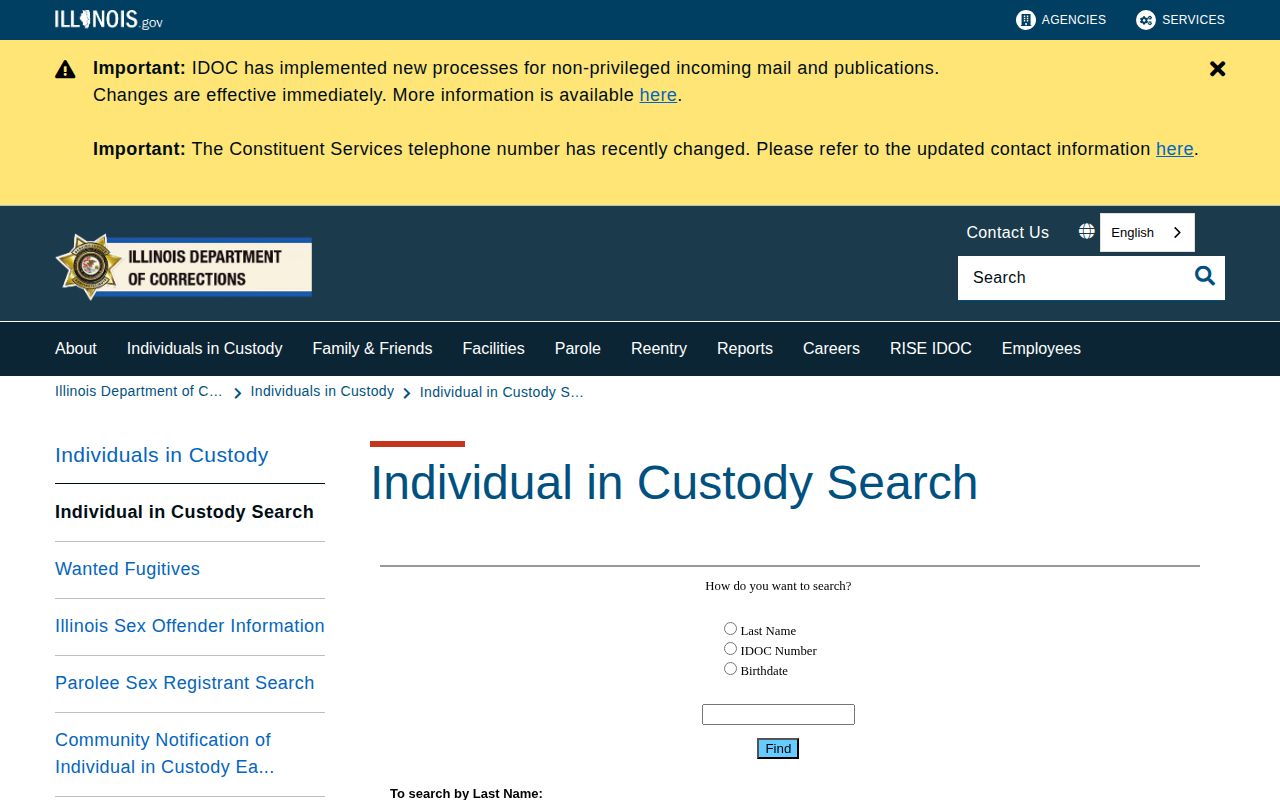
The official state search accepts a last name, IDOC number, or birth date. A full or partial surname may work, while IDOC number and birth date provide stronger identity controls. A returned profile contains identity and status information, followed by admission, release, discharge, and sentencing blocks.
| IDOC field | How to read it |
|---|---|
| Offender Status | The state status currently shown for the person |
| Location | The reported location, read separately from Parent Institution |
| Projected Parole Date | An anticipated institutional release to parole or MSR when applicable |
| Projected Discharge Date | An anticipated end of the sentence or supervision calculation |
| Last Paroled Date | A historical parole event, not proof of current supervision |
| Sentence Discharged? | A yes or no entry tied to a sentencing block |
Some records display “INELIGIBLE” or wording such as “TO BE DETERMINED” instead of a date. Do not create a date from the sentence length. Parent Institution may be an administrative association and not the person's immediate physical site. Always read it with Offender Status and Location.
The official IDOC offender search is the source for the live fields shown in the captured interface:
Menard County Jail Date Records
The Menard County Detention Facility is at 315 South Sixth Street, Petersburg, Illinois 62675, with jail and dispatch telephone 217-632-2273. Its public Zuercher view is locked to current inmates and does not publish a projected or actual release-date field. A negative result is therefore ambiguous.
For a pretrial detainee, inspect the Menard Judici docket for the latest detention or pretrial release order. Illinois' pretrial system no longer uses cash bail as the routine path, so older bond language on a sheriff page should not be turned into a present release forecast. A court order supplies legal authority, while the jail record shows when the custody change was carried out. Another warrant or hold may still block community release.
For a local sentence, request the existing sheriff record and compare it with the judgment and custody-credit entries. The sheriff need not create a calculation that it does not maintain. Ask for the admission and release date and time, release type, releasing authority, and destination or receiving agency as recorded.
Illinois Credit Rules Are Specific
Illinois has no universal “85 percent rule” for every conviction. Section 3-6-3 of the Unified Code of Corrections uses offense-specific and date-specific sentence-credit rules. Its baseline outside listed truth-in-sentencing and aggravated-DUI exceptions provides one day of sentence credit for each day of imprisonment or recommitment. Even that baseline should not be reduced to “everyone serves half.” Eligibility, discipline, additional credit, and the version of the law all matter.
Some truth-in-sentencing categories permit no more than 4.5 days of credit per month, often summarized as about 85 percent service. Other listed categories use different limits, including rules commonly described as 75 percent or 100 percent. Natural-life sentences receive no sentence credit under the specified subsection. The offense list has changed, so the current 730 ILCS 5/3-6-3 text, offense date, judgment, and IDOC calculation must control.
Menard County Earned Sentence Credit
Earned Sentence Credit is discretionary. IDOC says it cannot predict whether or when a specific person will receive it, and confidential master-record information limits individualized public answers. Program, education, service, and other statutory credit categories have their own limits and administration.
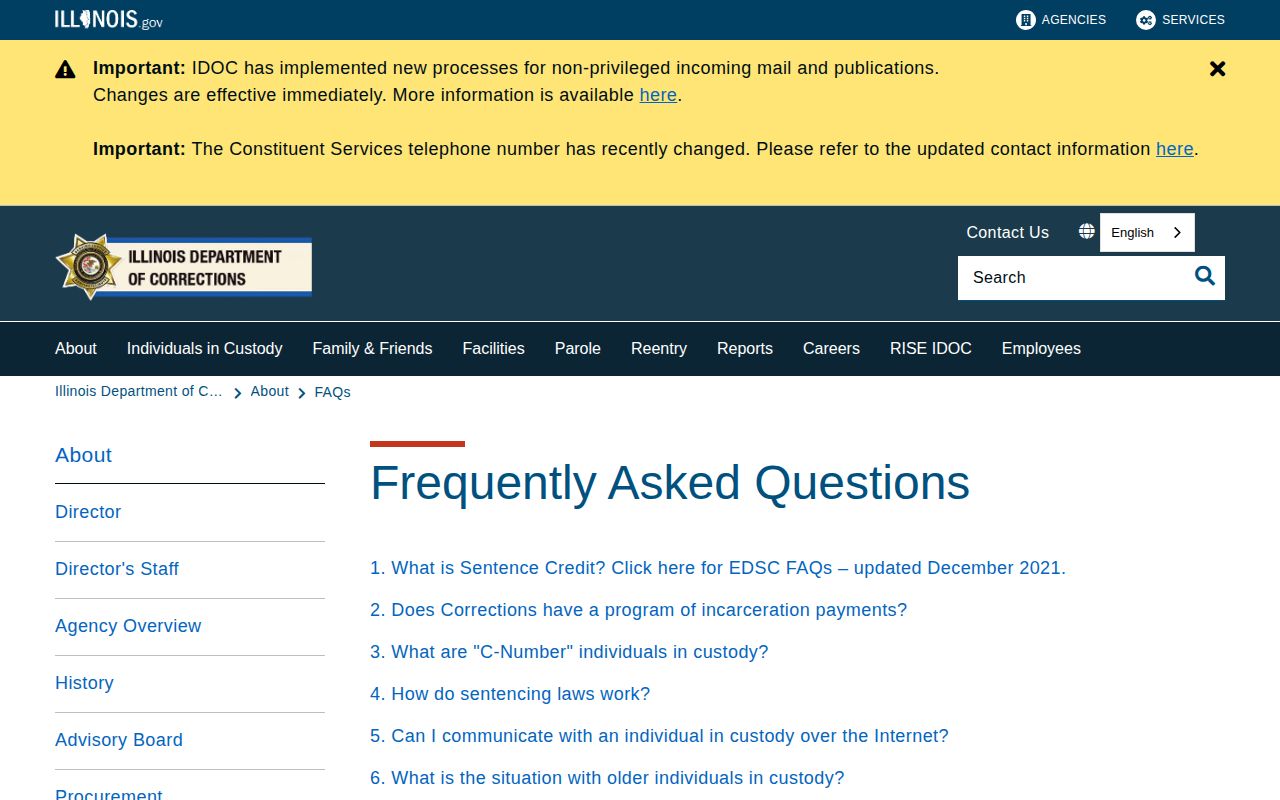
IDOC makes a narrower public commitment: when an award changes a projected parole date, the individual is notified and the adjustment is reflected on the public profile. That is why a date viewed last month may differ from today's display. The official IDOC sentence-credit FAQ is shown in the matched manifest capture:
Pre-sentence county custody can also affect the state calculation. Section 5-4.5-100 addresses qualifying custody credit, with the sentencing court awarding it and eligible county programming credit calculated under the statute. Menard has no public calculator that replaces the judgment and IDOC Records work.
What Changes Menard Release Dates
A date can move earlier, later, or become unavailable as the underlying record changes. The effect depends on the person's sentence and custodian. These factors should be verified, not applied as a home-made formula.
| Factor | Possible effect | Best record |
|---|---|---|
| Earned or statutory credit | May revise the projected parole date | IDOC profile and Records calculation |
| Disciplinary decision | May revoke or reduce applicable credit | IDOC disciplinary and sentence record |
| Court correction or new order | May alter sentence structure or custody authority | Judgment and docket |
| Concurrent or consecutive terms | Changes how terms combine | Sentencing order and IDOC calculation |
| Jail custody credit | May affect time credited before prison | Judgment, mittimus, IDOC record |
| Detainer or other hold | May cause transfer instead of community release | Holding and receiving agency records |
| PRB proceeding | May affect an eligible parole or violation matter | PRB calendar, decision, or result |
A PRB hearing date is not an automatic exit date. Modern determinate sentences generally move to MSR on the date IDOC Records calculates, while older indeterminate and other eligible cases may involve Board review. Even a grant may await its effective date, conditions, and resolution of holds.
Confirm Menard County Actual Release
Recheck the official profile on or after the projected date. For an IDOC case, compare status, location, projected fields, and any last-paroled or discharge entry. For a Menard jail case, call the facility and obtain the sheriff's executed release or transfer record. The court docket can confirm the legal order but may not show the minute custody ended.
A VINE notification can provide a timely lead when the specific person and reporting agency appear. The Menard County VINE inmate check describes conditional coverage and registration. An alert still needs source confirmation, especially when transfer is possible.
If an IDOC search returns nothing, discharge is one possible explanation, not the only one. A historical request should include the IDOC number if known, aliases, birth date, sentencing county and case, and the specific admission, institutional release, supervision, and discharge dates sought. Never substitute sentence arithmetic for a missing official record.